Kiss your darling bakery goodbye and make your own fantastical mini custard pies with zero sugar. Monk fruit sweetener is a sugar substitute you can find at your supermarket. It is generally mixed with erythritol, and people use it that are trying to eat less sugar, or quit sugar, follow a keto diet or have diabetes.
I’ll get straight into the full recipe below after the brief introduction, so that you don’t have to scroll down to get the details.
However, after the mini custard pies recipe there are tips and variations that are worth reading, so make sure to check them out.
I make my day easy by using pre made puff pastry from my supermarket. Interestingly, it generally doesn’t have sugar added. Check the ingredients on the back to make sure.
Then for the custard filling, I use 3 tbsp of the monk fruit sweetener. If you prefer to just use sugar, that’s absolutely fine, just use 3 tbsp of sugar.
I bake them in a silicone 12-hole muffin tin. Using a silicone muffin tin saves time as nothing sticks in there so I don’t have to grease it or use baking paper. But if you don’t have one, I cover other options below.
If you like these, you’ll love the mini banana cream pie, also made with puff pastry.
So let’s get to it! Here is the recipe for mini custard pies. Scroll down to see some notes, extra info on serving and variations.
This mini custard pies recipe is also available as a video course on Skillshare. Watch now with one month free access: https://skl.sh/394hV6a
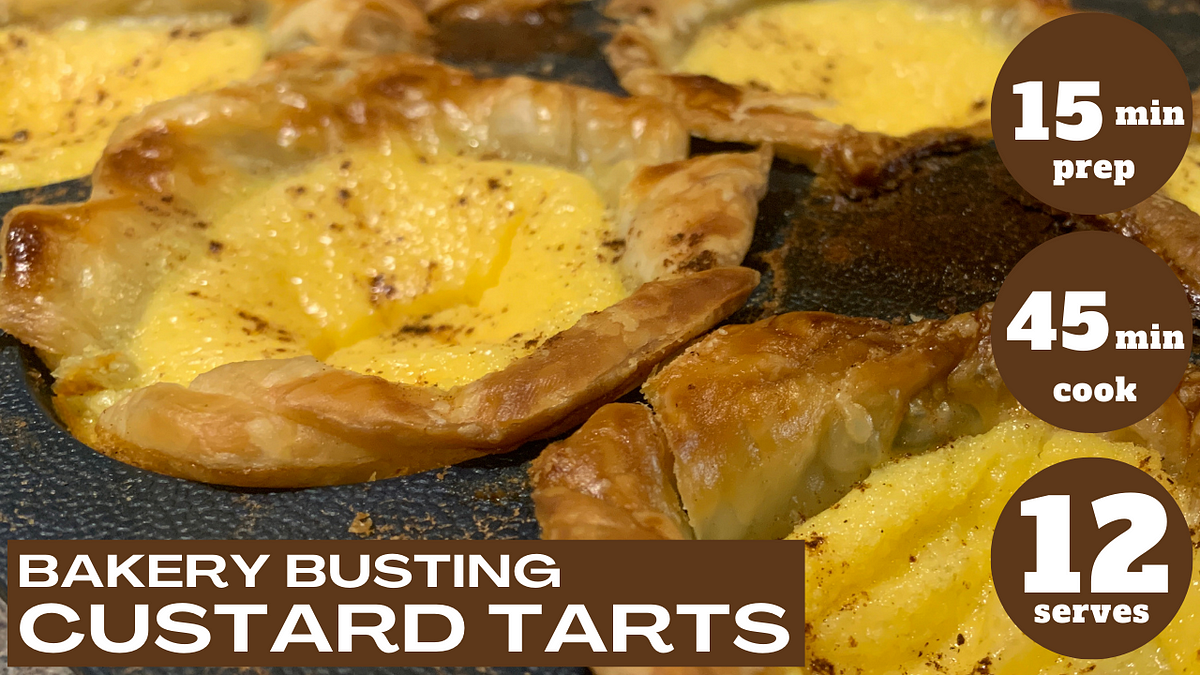
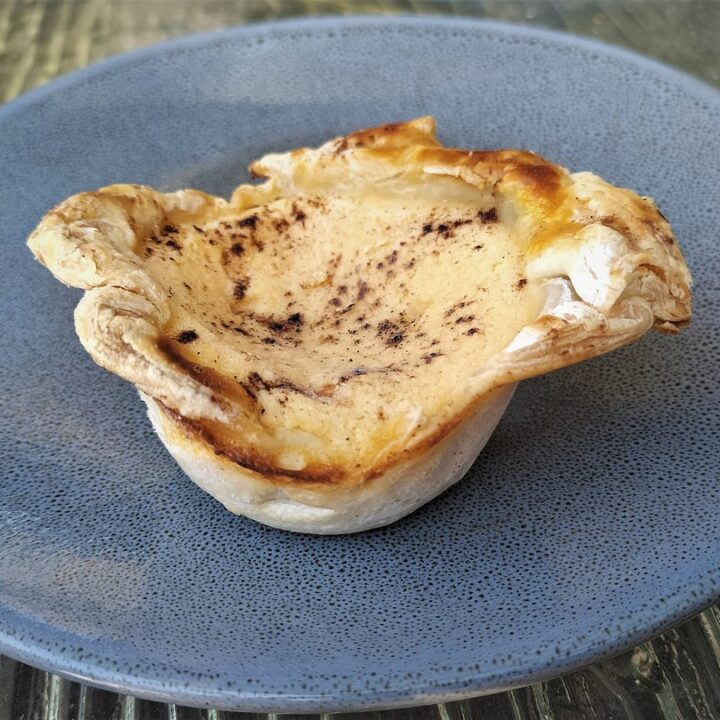
Mini Custard Tarts
Ingredients
- 2 sheets of store bought puff pastry
- 2 eggs
- 1 egg yolk
- 1 tsp vanilla extract
- 3 tbsp monk fruit sweetener (or sugar if you prefer)
- 1 cup thickened cream
- 1/2 cup milk
- 1/4 tsp cinnamon
- 1/8 tsp nutmeg
Instructions
- Defrost the puff pastry. This should take about 20 mins. It is ready when it is soft and malleable. Meanwhile preheat the oven to 160 Celsius.
- Using a sharp knife, cut each sheet of puff pastry in half down the middle, and each half into three. You should be left with 12 rectangles.
- Pull out your 12 hole silicone muffin tin. I don’t bother greasing it. Take one pastry rectangle and shape it into a muffin hole, it’s ok to pull it and mush it to fit. What you want is for the entire muffin hole to be covered as evenly as possible. Don’t allow any holes, if the pastry tears mush the two ends together to cover up the hole. Go all the way up the sides and slightly over the edge.
- Using a fork, poke a few holes into the pastry at the bottom of each muffin hole. Place in the oven and bake for 15 mins.
- Meanwhile, make the filling. In a large bowl, whisk together the eggs, egg yolk, vanilla extract, sweetener or sugar, thickened cream and milk. Make sure to mix it really thoroughly so there are no streaks of egg in the filling (otherwise you will have streaks of egg in your cooked pies).
- Take the pie bases out of the oven and allow to cool for 5 mins. Some of the sides might have collapsed while cooking, so gently pull these up and try to get them looking as even as possible and as high up the sides as you can.
- Now it’s time to fill your pie bases. Place your silicone muffin tray on top of a large baking tray first. When you’re moving it full of liquid later, you’ll be happy that it’s on a steady surface.
- Using a ladle or a large spoon, fill up all the cases. Try to avoid any of the filling to sneak behind the pastry and down into the bottom of the muffin hole. Don’t fill them above the pastry line.
- Place in the oven in the middle rack and bake for 10 mins, then rotate the muffin tin around so that they cook evenly. Bake until JUST set, roughly another 10 mins. You will know they are done if the top is slightly browned, and the custard is no longer liquid but still jiggles when moved.
- If in doubt, pop a knife into the middle of one of the tarts. If liquid pours out, bake for another couple of minutes. If there is no liquid pouring out, you are done. It will be soft and creamy, that’s ok it will set as it cools down.
- Take them out of the oven. Sprinkle the cinnamon and nutmeg evenly over all of the pies.
- Allow to cool for about half an hour. Ideally when you can touch them, you would take them out to cool completely on a wire rack. If you don’t have a rack it’s okay, just let them cool in the muffin tin.
- Then place them in the fridge and allow to set for at least half an hour. You can leave them to set for a few hours or overnight.
Notes
The nutrition information is if you used monkfrut sweetener.
Nutrition Information
Yield 12 Serving Size 1Amount Per Serving Calories 105Total Fat 9gSaturated Fat 5gTrans Fat 0gUnsaturated Fat 4gCholesterol 70mgSodium 29mgCarbohydrates 3gFiber 0gSugar 2gProtein 2g
Notes
- Usually puff pastry comes in sheets of 6 or more in the packet. To store the rest of the packet of unused puff pastry, after you’ve gotten out 2 sheets to use in this mini custard pies recipe, place the rest of the puff pastry in a plastic bag, and close with a bag clip or an elastic band. Return to the freezer to store for next time.
- Vanilla extract — I like to buy pure vanilla extract with no sugar added. Always check the back of the label as a lot of “vanilla essence” is sugar syrup with vanilla flavour.
- If you don’t have a silicone muffin tray, use a normal one. Grease all the holes with oil (you can use your hands or a pastry brush). Then sprinkle some flour over the oil to make it extra non-stick. The oil/flour combo replaces the need for baking paper. (Yay for reducing single use things!)
- If you are more of a sweet tooth, feel free to double the amount of sweetener or sugar in the mini custard pies!
The Global Love for Custard Pies: A Dessert with Many Traditions
Custard pies have been a beloved dessert for centuries, originating in medieval Europe, particularly in England and France, where they were enjoyed in royal courts and even served at the coronation of Henry IV.
Over time, different regions developed their own variations, making custard filled pastries popular in many countries. In Portugal, the famous pastel de nata features a caramelized custard filling in a flaky pastry shell.
In China and Hong Kong, egg tarts (dan tat) became a staple in dim sum cuisine, influenced by both Portuguese and British baking traditions.
In Australia, large custard pies, mini custard pies and medium sized custard pies from local bakeries across the country all remain a classic dessert, always topped with a sprinkle of cinnamon.
No matter the variation, custard pies are loved worldwide for their silky texture and comforting sweetness.
Variations:
Here are some variations on the mini custard pies recipe:
Old-Fashioned Custard Pie in a Large Cake Tin
If you prefer, you can make an old-fashioned custard pie in a 20 or 25cm round cake tin. Still follow the recipe, just use all of the puff pastry to line the large tin and then when it’s time to fill it, pour all of the filling into the cake tin, and pop into the oven.
You will need to bake a large old-fashioned custard pie a bit longer than if you’re making mini custard pies. For the large one, bake for 20mins, then rotate in the oven to make sure it cooks evenly, and cook another 15mins, then check to see if the pie is ready. If liquid is still pouring out when you put a knife in, bake another few mins until the liquid is just set.
Let it cool then place in the fridge to set, and then when you’re ready to serve, slice into individual pieces.
Custard Pie With Fruit
If you want to make custard pie with fruit, follow the above recipe, and after the mini custard pies have set in the fridge, chop up some fresh fruit and arrange on top of the pies.
You can add some fresh berries too if you like. For a bit of extra flair, spread some apricot conserve on the custard first, then arrange the fruit and berries on top.
Gluten Free Custard Tarts
To make gluten free custard tarts, don’t use puff pastry, and instead make your own base. Use 1 cup of macadamia nuts and 3/4 cup gluten free oats, blend in your food processor until they are very fine. Then add in 1/4 cup melted butter and blend again. (If you like you can add 1 tbsp of sweetener or sugar here).
Then press this nut goo into the holes of your muffin tin, along the base and a bit up the sides. There is no need to prebake this gluten free base, just spoon your egg goo right in there and then bake, following the above recipe.
Dairy Free Custard Tart
To make a dairy free custard tart, or dairy free mini custard pies, follow the above recipe but instead of using thickened cream and milk, use coconut pouring cream and your choice of alternative milk. You can make the dairy free custard tart a large one if you like.
The coconut pouring cream is not the coconut cream in a can, but the one in the supermarket with the mini UHT milks, and comes in a small UHT milk tetra pack. In some health stores you can also find coconut pure cream, in the fridge with the sour cream and dollop cream, this would also work.
Also check the back of the puff pastry to make sure it is dairy free, I have found they usually are.